Nappies: Care, Washing and Disposing

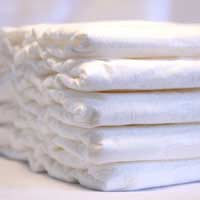
Babies use an extraordinary number of nappies before they are potty trained and parents must safely discard disposable nappies, or be sure that fabric ones are thoroughly cleaned and disinfected before reusing them. It is really a simple matter, but you must take care of soiled nappies quickly and regularly or they will give your home a very unpleasant odour.
Choosing Nappies
Disposable nappies account for only a small percentage of household waste, but they are not biodegradable and experts estimate that nappies discarded today will still be sitting in landfills 400 years from now. While some environmentalists recommend that parents use fabric nappies rather than the disposable types, others acknowledge that the detergents and sanitisers used to clean fabric nappies pose risks to the environment, too. Ultimately, parents must choose to use the type of nappies that they prefer and no matter what they select, they will need to do something with the nappies that their baby soils.Disposing of Disposables
Soiled disposable nappies should be transported as quickly as possible to an outside bin so that their odour doesn't remain in the house. There are a number of manufacturers that offer products that wrap disposable nappies and seal them tightly to contain the odour until the opportunity arises to take them outdoors. Many parents, especially those living in an upper floor flat, find these products to be very helpful.Washing Fabric Nappies
Nappy services are widely available and offer a valuable and convenient service for busy parents. Most often, parents and other caregivers are asked to remove solid waste from nappies and store them in a tightly sealed container for pick up at a predetermined time. Upon pick up, the nappy service will trade the soiled nappies for a supply of fresh ones, clean and ready for use.To save money, some parents chose to launder soiled nappies themselves. As in preparing the nappies for a service, parents should remove all solid waste before laundering. Nappies should be washed according to their manufacturer's instructions, which may vary a bit depending on the type of fabric. Frequently, nappies are all cotton and are washed in hot water using detergent and sanitiser. While many parents boil nappies or pre-soak them in diluted bleach, the use of some brands of sanitiser make bleaching or pre-soaking unnecessary.

Re: Ultrasounds - What is EFBW and GMS?
My wife is 32.6 weeks ...and the babys weight is 1971gms...is that normal or not...please reply me.....
Re: Ultrasounds - What is EFBW and GMS?
my 18th week and baby weight 252 it is gud or bad...please tell me....
Re: Ultrasounds - What is EFBW and GMS?
Hello!i have 21 weeks and 4 days pregnancy.. and my EFBW is 430gms.. is that normal?? Will my baby healthy or not??
Re: Abdominal and Pelvic Pain During Pregnancy
Left pelvic pain, backpain pregnency positive' is any problem, already ectopic happen
Re: Ultrasounds - What is EFBW and GMS?
My wife is 21 week 2 day . In scan report EFRW 415 GM is normal or not . Can you please help me to know current status of…
Re: Ultrasounds - What is EFBW and GMS?
I am 34.1wks pregnant my baby weight is 2215gm is my baby healthy
Re: Ultrasounds - What is EFBW and GMS?
My wife is 37weeks 5days pregnant E.F.B.W - 3010 grams how is she
Re: Ultrasounds - What is EFBW and GMS?
I am pregnant of 36 week 2 days and my EFBW is 1949 is it normal..?
Re: Ultrasounds - What is EFBW and GMS?
i had my ultrasound rhis sept 19 i wonder what is rhis number for efbw 2336 stands fir can you please give me an idea…
Re: Ultrasounds - What is EFBW and GMS?
my wife is 16.2 weeks and done early tiffa scan. E/O an elongated anechoic lesion with minimal internal echogencity…