If you experience unexpected abdominal and pelvic pain during pregnancy, it's easy to worry. But while some pain may need medical attention, sometimes instances of pain are relatively harmless.
Some Reasons for Abdominal Pain
As you go through pregnancy, you may find that you experience various pains in the abdominal area; these are generally normal although they can be very painful or uncomfortable. Here are some of the reasons you may experience abdominal pain:
1. Early Pregnancy - When the Embryo Starts to Embed itself
Discomfort in the abdominal area is common during Early Pregnancy. One of the first times when you may experience pain is around the time of your first missed period. For a day or two, some women have a pain that's low down in the abdomen and feels a bit like a dull period pain, as if your period is about to start. It's thought that this is because the embryo is beginning to embed itself in the soft lining of your uterus at this time.
2. The 3rd/4th Month - Ligament Aches
During the third or fourth month of pregnancy, women frequently get a sharp stabbing pain in their groin or to one side. It may come on at sudden intervals, might be worse if you suddenly get up, stretch or move and it might disappear then reappear a few days later. It can be really worrying to suddenly get pains like this, but usually it's due to the ligaments or muscles around your uterus in your pelvis stretch and thicken as they support your growing baby.
3. When the Baby Grows - Constipation and Bloating
Constipation, bloating and wind can also cause aches, pains and abdominal discomfort. Constipation is often caused by the pressure of your growing bump on your rectum, as well as hormones which are said to slow down the movement of food through your digestive system. These factors are also involved in bloating and wind, too, with your growing uterus pressing on your intestines.
4. Later Pregnancy - Braxton Hicks
In later pregnancy, Braxton Hicks contractions may cause some pain. These contractions, which are irregular tightenings of the uterus, can occur from early pregnancy, but most women don't notice them until the latter half. They're generally started of by either you or the baby moving, or if someone touches your stomach. It's a normal part of pregnancy, but can feel very odd. If you're concerned or the contractions become more frequent, talk to your doctor.
Abdominal Pain to Worry About
During early pregnancy it is always advisable to seek medical advice with any abdominal pain. The first thing the doctors/midwife will check for is ectopic pregnancy.
Ectopic Pregnancy
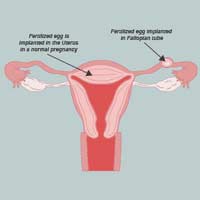
Ectopic pregnancy happens when the fertilised egg implants itself outside of the womb. The most common place for this to occur is in the fallopian tube, this is known as a tubal pregnancy. Ectopic pregnancies can also occur in an ovary, the abdominal space and also in the cervix (which is the neck of the womb).
Here are a few things to note about ectopic pregnancies:
Ectopic pregnancies are serious and because of where the egg has implanted itself in the fallopian tube it can not be saved
With ectopic pregnancies early diagnosis is key, if diagnosed early the pregnancy can be ended safely and without any complication
Ending the pregnancy would be done using medication or surgery depending how far along the pregnancy is
Early diagnosis also greatly improves chances of a normal pregnancy at a later date. If it is not diagnosed and is left untreated a tubal pregnancy can be fatal, the fallopian tube can split causing internal bleeding and blood loss
Facts About Ectopic Pregnancies
In the UK 1 in 80 pregnancies is ectopic
There are at least 11,000 ectopic pregnancies in the UK each year
In the UK 5 (approx) women die each year from ectopic pregnancy.
Abdominal Pains: When to Contact a Medical Professional
If you're at all worried about the abdominal pain you're getting, always consult a doctor, midwife or maternity unit immediately. This is particularly so if you experience any of the following symptoms:
During early pregnancy – severe cramp in your lower abdomen, which lasts for several hours, is accompanied by vaginal bleeding and doesn't ease. This could be the signs of a Miscarriage.
During early pregnancy – severe pain on one side of your lower abdomen, plus bleeding or a brown discharge from your vagina. This could be sign of an ectopic pregnancy.
At any time – pain or discomfort when urinating, a fever, pelvic discomfort, a frequent urge to urinate, chills, pain in your lower back or side, nausea, vomiting or blood in your urine. This could be a sign of a Urinary Tract or kidney infection, which being pregnant makes you more susceptible to.
During later pregnancy – pain in the upper abdomen, along with symptoms such as a very bad headache, nausea, vomiting, flashing lights or seeing spots in front of your eyes. This could be a sign of Pre-eclampsia.
During later pregnancy – severe pain in your lower abdomen, with or without bleeding. This could indicate a separating placenta.
Pelvic Pain
Occasional aches in your pelvic region are common and usually nothing to worry about, but one in 35 women get pelvic joint pain (Symphysis Publis Dysfunction). During pregnancy, a hormone called relaxin is released, which softens the joints ready for the birth of your baby. But for women with pelvic joint pain, the hormone goes overboard and causes the ligaments to soften and stretch too much.
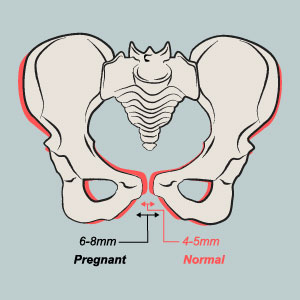
The pelvis is made up of four separate bones which are joined at the front by the symphysis pubis and it's normal for there to be a gap of 4-5mm between the two pubic points. During pregnancy, the gap widens by another 2-3mm, but when it stretches too far it results in pain and discomfort. This normally occurs from the second trimester onwards, but it can happen at any stage or even after you've given birth.
The Symptoms for SPD Include:
Pain in your pubic area and groin.
Pain in the inside of your thighs.
Lower back and hip pain.
Pain when you walk, move or go up stairs.
A clicking sound that you can hear.
A feeling that your bones are grinding together.
Difficulty and pain when you try to open your legs.
If you experience any of these symptoms, then speak to your doctor or midwife. If they do think it's SPD, you'll be referred to an obstetric physiotherapist, who can offer the best course of treatment. It can make giving birth a bit uncomfortable, but make sure everyone knows what's wrong and that you find a position that is comfortable for you.
Pain Relief in Pregnancy
There are many times during pregnancy when you'll experience twinges or even 'non-pregnancy' pains like headaches and so on. Read our Pain Relief feature if you are wondering what kind of remedy is safe to take, at each stage of pregnancy.
Business Energy With a Difference
If you are looking for business energy or need advanced solutions like remote energy monitoring, new supplies, downgrading or upgrading capacity, have a no obligation chat with Purely Energy.
Left pelvic pain,backpain pregnency positive' is any problem, already ectopic happen
Savi - 13-Mar-20 @ 11:27 AM
Am 8n half months pregnant an am feeling pain between my legs ,my back and my waist wen am walking.
Proff - 24-Dec-17 @ 6:13 PM
I’m 4 days late for my period and I’m have real bad cramps in my lower stomach and I haven’t taking a test because I want to see if my period come on
Mrs.Yectli - 20-Nov-17 @ 7:24 AM
Kirsty - Your Question:
Hi wonder if you could help I wet to epu and was told they couldn't find a heartbeat I started heavily bleading and been told to wait till Friday to have another scan which is 8 days well the last 2 days I've had real bad pain in my groun eria that keeps coming and going real strong an din my back I'm only 8 weeks so deffo not labour but the pain is still there I'm worried it's something not related to the pregnancy and I'm scared please help!!
Our Response:
Sorry but we can't give individual medical advice, youreally should go back to the doctor about this.
BabyAndPregnancy - 6-Oct-17 @ 2:32 PM
Hi wonder if you could help I wet to epu and was told they couldn't find a heartbeat I started heavily bleading and been told to wait till Friday to have another scan which is 8 days well the last 2 days I've had real bad pain in my groun eria that keeps coming and going real strong an din my back I'm only 8 weeks so deffo not labour but the pain is still there I'm worried it's something not related to the pregnancy and I'm scared please help!!
Kirsty - 4-Oct-17 @ 6:02 PM
ken - Your Question:
Hi.am 24 weeks pregnant and have a pain on my left side more so that sometimes it feels like am having my period.plis help am worried.
Our Response:
We can't really give medical advice here. The above article suggests reasons for experiencing pain in pregancy but, you should really check any concerns out with a doctor or midwife.
BabyAndPregnancy - 23-Jun-17 @ 10:19 AM
Hi..am 24 weeks pregnant and have a pain on my left side more so that sometimes it feels like am having my period....plis help am worried..
ken - 22-Jun-17 @ 7:27 AM
Court - Your Question:
I'm almost 14 weeks pregnant with my first baby and am experiencing strong cramps in my lower right side of my stomach. No bleeding though. Should I be worried? Needing advice #FTM
Our Response:
There are various reasons for stomach cramps and it's probably nothing to worry about. Your midfwife or GP will be happy to discuss this with, so please do make the time to go and get this sorted out, even if it's just to reassure yourself.
BabyAndPregnancy - 19-Jun-17 @ 2:10 PM
I'm almost 14 weeks pregnant with my first baby and am experiencing strong cramps in my lower right side of my stomach. No bleeding though. Should I be worried? Needing advice #FTM
Court - 15-Jun-17 @ 8:20 PM
am almost 15weeks pregnant, am feeling pain in my stomach, actually I can't really describe how painful am feeling right now, please what your advice
Asakea - 8-Jun-17 @ 10:35 AM
Great read on Pelvic Pain,
Thanks,
Dr Novikova
Michelle Savvy - 29-May-17 @ 1:30 PM
Hallo morning, I'm almost 32 weeks Pregnant and I'm experiencing severe pain on my right side of my stomach for the past 4 days and also sleepless night. Please I need an advice
Awsin - 22-May-17 @ 3:35 AM
Hi I am 15 weeks pregnant an having a lots of Lower stomach pain an alote of pelvic pain an some time I have a really bad tighing in my stomach an it has alote of pain that goes with an an the pains is usual in my upper stomach .. is this any thing I should be worried about
Wingrove - 12-May-17 @ 11:04 PM
Right side pelvic pain in night
Pregnant 6 weeks
No bleeding nothing
Fami - 7-May-17 @ 4:10 AM
Hi am 3weeks pregnant have sm cramps n backach its as if am going into my periods what could b the problem n cause n the pains come in my ceasorior I was operated with the first baby
Nini - 27-Apr-17 @ 10:39 PM
Im 22wks 4days pregnant im having sharp pains in my right side of my stomach area,headache,and some pressure. Should I be worried?? What could it be??
Hisforever - 28-Mar-17 @ 3:54 AM
Hi im 31 weeks pregant with my first. Within the last few weeks i have been experiencing sharp pains in my pelvic area along with a constant pain in my groin whenever i move my leg up or to the side. I have also started getting cramps in my lower back and in my abdomen and it feels like im going to start my period. On top of that when i walk for a long period of time my left side starts to cramp up and it hurts so bad i have to stop moving until it goes away. Im not sure if i should be worried or not. I have not talled to my obgyn yet because my next appointment isnt till Wednesday. I need some advice.
Tee - 25-Mar-17 @ 4:39 PM
I am 11 weeks pregnant and I went to urinate and felt a sharp pain in run through my womb to the entrance of my cervix. And I suffer from cervical incompetence should I be worried
Toya - 18-Mar-17 @ 8:19 PM
Mummyto babies- Your Question:
I have been having sharp pains in my back and side and really bad headaches and flashing lights in my eyes and the constant need to pee (more than normal pregnancy )struggling to eat and drink really worried that something might be wrong
Our Response:
Please see your GP or midwife about this, we can't really help on specific medical questions. Good luck.
BabyAndPregnancy - 17-Mar-17 @ 10:45 AM
I am 15 weeks pregnant and I am getting a pain on my left side of my womb.is it dangerous for the baby.?
dipz - 16-Mar-17 @ 7:24 AM
I have been having sharp pains in my back and side and really bad headaches and flashing lights in my eyes and the constant need to pee (more than normal pregnancy )struggling to eat and drink really worried that something might be wrong
Mummyto babies - 15-Mar-17 @ 11:16 AM
Hi was wondering if someone could please help me out. .
I was on ivf treatment last Dec through to Jan 2017....I stopped the treatment as I had a slight over hyperstimulated ovaries...
Since then I had a cycle on the 14th January that was ok....not sore or heavy...
Since then I have had no cycle but slight blood when I wipe....this was when I was due...last month
Since then i have a really hot lower back pain...pains in my front passage running to toilet...pressure on my bladder...hot flushes and fatigue...
I have been in time gynae and had my womb checked and all looked ok...they said I had a small cyst on my right ovary...but they did a ultrasound scan and in my uterus it showed a black peanut sized small black dot in the middle...they were baffled and asked did I do a pregnancy test I said I had done loads and came back negative...they made me wait for the resilt and it came back negative....has anyone had these symptoms and been pregnant and it not show on the blood test...
Losing my mind....any advice of similar problems would get greatly appreciated
Zo - 13-Mar-17 @ 12:23 PM
minenhle - Your Question:
I'm 16 weeks pregnant and I experiencing pain in my wombs can I should be worry
Our Response:
Not necessarily, but we really can't say. You should get this checked out by your GP.
BabyAndPregnancy - 2-Mar-17 @ 2:26 PM
I'm 16 weeks pregnant and I experiencing pain in my wombs can I should be worry
minenhle - 1-Mar-17 @ 12:39 PM
Am 2 weeks pregnant,but my pelvic is really worse,plz help me is it normal
hudsh - 28-Feb-17 @ 5:34 AM
I'm due on 22nd Feb but my period started on 25th and have been trying to conceive, now the pain is different from the way Iuse to feel before, Im feeling sharp pain at lower abdomen at right side up to my thigh, please help me out I don't understand what causes this pain for the past two days now.
flavour - 27-Feb-17 @ 10:55 PM
Sammy - Your Question:
Im due march 5th but been having serve pain when laying down and getting up limp most of the time and if I sit on the floor it hurts like a sob to get up. Ive talked to my doctor and seems nothings wrong its my 4th pregnancy and this pain started 2 montha ago. To turn around on my other side when sleeping hurts to turn over the pain is horrible
Our Response:
What does your midwife say? We're guessing you're now on weekly visits to her/him by now? If it reassures you, you should ask for a second opinion and as it's your 4th pregnancy, they should not dismiss your worries - or should at least address the pain issue for you.
BabyAndPregnancy - 24-Feb-17 @ 12:03 PM
Im due march 5th but been having serve pain when laying down and getting up limp most of the time and if i sit on the floor it hurts like a sob to get up. Ive talked to my doctor and seems nothings wrong its my 4th pregnancy and this pain started 2 montha ago. To turn around on my other side when sleeping hurts to turn over the pain is horrible
Sammy - 21-Feb-17 @ 10:51 PM
My wife 17weeks pregenant and she is having a pelvic pain while passing a urine nd feeling too far of it .... it's quiet normal one huh...
Logu - 13-Feb-17 @ 4:12 PM
cass95 - Your Question:
I am going to be 4 months on the 12th and I'm having extremely bad pain in my pelvic area when I use the restroom sometimes. I'm not spotting blood or having brown discharge. And this is my first pregnancy so I am really worried about why I am having bad pain there.
Our Response:
There could be a simple reason for the pain, but please see your doctor or midwife so they can make sure.