Caesarean Section

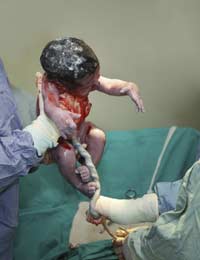
One in six women have a caesarean birth, either due to an emergency situation or because it's been pre-decided for various reasons. But what exactly is involved and how long will it take to recover?
There are two main types of caesarean, or c-section as it's also known - an elective caesarean or an emergency caesarean. An elective caesarean is decided in advance of you going into labour, normally due to issues concerning either your health or the health of your baby, whilst an emergency one takes place after you've gone into labour. There are various reasons why you might need a caesarean including:
- A low-lying placenta that's blocking your baby's exit.
- Your baby's head is too large to fit through your pelvis.
- Difficulty due to the size or shape of your pelvis.
- Your baby is in the breech position (feet first).
- Your baby is in a tricky position.
- Your baby is distressed or suffering from a lack of oxygen and can't be delivered by forceps or ventouse.
- You're suffering from eclampsia or pre-eclampsia.
- Your health and existing medical conditions, such as heart problems.
- You've had a long labour and are too exhausted to push any longer.
- You're having twins, triplets or multiples.
- You're giving birth prematurely.
What Happens Next?
If a caesarean is necessary, you'll have to sign a consent form first, giving permission to have it carried out. You'll be given an anaesthetic in the form of an epidural or spinal injection, so you can stay awake (although in some circumstances, a general anaesthetic may be required). A screen will be placed across your abdomen so you can't see what's going on and you'll be able to have someone by you, to hold your hand or talk to you. You'll also be wired up to a heart monitor, so they can keep an eye on your heartbeat.An incision is made low down on your abdomen, above the pubic hairline, and the surgeons will then remove your baby. Whilst the baby is being helped out of the womb, you may have slightly strange sensations, but it's normal and isn't a sign that you anaesthetic hasn't worked. All in all, it doesn't take long and your baby should be born within 10 minutes of the operation starting.
Your baby will be checked to ensure they're okay, then you're able to hold them. Whilst you're holding your baby, the placenta and membranes will be delivered and then the surgeon will stitch you up. This part takes about 30 to 40 minutes.
Recovering
After you've had a caesarean, it will take a bit of time to recover, especially if it was an emergency one and you weren't expecting to have had a caesarean. It's normal to feel tired and washed out for a few days and you may experience some pain and aching in your abdomen, as you've had an operation. Immediately after the op, you may well be on a drip, to ensure you're properly hydrated, you may have a catheter and a little tube to catch blood that pools under the scar. As far as stitches go, they'll either be dissolvable or need removing at a later stage.You won't be up and about as soon as women who've had vaginal births and you'll need someone at home to look after you for at least a week after you leave the hospital. You'll need to get plenty of rest to ensure you make a full recovery - it will take at least six weeks for you to heal - and, at first, all you should concentrate on doing is feeding your baby.
If you've had a caesarean for a particular reason, such as a health issue, then you may need to have another for any subsequent pregnancies. However, many women do go on to successfully have a vaginal birth in the future.
As with any operation, there are risks involved with caesarean's (developing an infection is a key one), but hospitals are fully geared up to carrying them out and on average do 10-20 per week. If you want to find out more about caesarean sections in case it happens to you, have a chat to your midwife or doctor.
- Natural Ways to Bring on Labour
- How Much Weight Gain is Expected During Pregnancy?
- What is a Retained Placenta?
- When Can You Expect to Feel Your Unborn Baby Moving?
- Admission Procedures and Early Labour Checks
- Everything You Want to Know About the Placenta
- What Positions Are Best for Labour?
- Is a Natural Delivery Possible After a Caesarean Section?
- What Happens If I Get a Tear During Childbirth?
- Choosing a Birthing Partner
- What Happens When My Waters Break?
- Is it Possible to Have a Pain-free Labour?
- Am I in Labour?
- God Parents and Guardians
- What to Pack For Labour
- What Does Dad Need For the Birth?
- Getting Ready For a New Baby
- Giving Birth: Pain Relief Methods
- Having a Home Birth
- Making A Birth Plan
- Useful Skills When Going Into Labour
- Waterbirth Safety
- Assisted Birth Delivery Methods
- Baby Shower Basics
- Birth Induction
- Hypnotherapy and Hypno-Birthing

Re: Ultrasounds - What is EFBW and GMS?
My wife is 32.6 weeks ...and the babys weight is 1971gms...is that normal or not...please reply me.....
Re: Ultrasounds - What is EFBW and GMS?
my 18th week and baby weight 252 it is gud or bad...please tell me....
Re: Ultrasounds - What is EFBW and GMS?
Hello!i have 21 weeks and 4 days pregnancy.. and my EFBW is 430gms.. is that normal?? Will my baby healthy or not??
Re: Abdominal and Pelvic Pain During Pregnancy
Left pelvic pain, backpain pregnency positive' is any problem, already ectopic happen
Re: Ultrasounds - What is EFBW and GMS?
My wife is 21 week 2 day . In scan report EFRW 415 GM is normal or not . Can you please help me to know current status of…
Re: Ultrasounds - What is EFBW and GMS?
I am 34.1wks pregnant my baby weight is 2215gm is my baby healthy
Re: Ultrasounds - What is EFBW and GMS?
My wife is 37weeks 5days pregnant E.F.B.W - 3010 grams how is she
Re: Ultrasounds - What is EFBW and GMS?
I am pregnant of 36 week 2 days and my EFBW is 1949 is it normal..?
Re: Ultrasounds - What is EFBW and GMS?
i had my ultrasound rhis sept 19 i wonder what is rhis number for efbw 2336 stands fir can you please give me an idea…
Re: Ultrasounds - What is EFBW and GMS?
my wife is 16.2 weeks and done early tiffa scan. E/O an elongated anechoic lesion with minimal internal echogencity…